Showing posts with label books. Show all posts

Monday, July 9, 2012

Always late but worth the wait

Wow. Has it really been three months since I last blogged? This is both highly unacceptable and highly unbelievable. Where has the time gone? The last three months have gone by so fast, and so much has happened since my last post. . .

First off, I turned 30 in April (insert giddy exclamation marks here). Overall the experience was a little underwhelming. I guess I assumed that turning 30 meant undergoing some giant epiphany about life and the future and all those "adult" things you see in movies. But let's be honest, I pretty much have life figured out so there were no new lessons learned. All I found out is that Swiss fondue really is my favorite dinner food (nom nom) and I can't get enough of fresh fruit tarts (another double nom). My parents surprised me with a nice Canon Rebel camera as a birthday present since I've been wanting one to take more professional-quality pics once the bébé arrives, and J bought me a little gold feather "freebird" necklace from Nordstroms that I've wanted. I was a little worried (read: ready to punch him in the face) that J wouldn't be spending my birthday with me since he had a trial set that week and had been staying up late every night leading up to April preparing his case, but luckily the case settled the week before my 30th so all was copacetic in our household. Thirtieth birthdays, after all, only come once in a lifetime.

Know what else comes once in a lifetime? (Well, once if you're lucky?) Five-year wedding anniversaries. . . which is what J and I will be celebrating on July 20th!! I can't believe it's already been five years since we tied the knot, but I guess you know you're in love when five years feels like five days. We don't have anything planned at the moment (although let's face it, a trip to Italy would be divine -- and also completely unrealistic), but we'll probably spend it picnicking in Napa for the day, maybe eat at a nice restaurant that night. I really have no clue and for the first time that I can remember, it doesn't bother me. Who am I? It's funny: The older I get, all I care about is just spending quality time with him. We don't need to do anything extravagant for me to be happy. Some of my favorite times with J are holding hands in the car on our way somewhere, or lying on a blanket together in a park. Sometimes it all feels too perfect, like I'll wake up one day without him and find out it never happened. But then I wonder why can't some love stories be nearly perfect? For right now it is and it has been and I hope it stays that way till we're into our 90s. For now just looking over at him reading before we fall asleep is all it takes to make me smile:


Aside from home remodeling, the past few months I've been busy writing and am happy to report that I've just hit about 100 pages into my newest book idea. I don't know whether it's all these extra hormones flying off me or maybe bébé is my new muse, but I feel a rush of creativity and I suddenly have the daily motivation to do something about it. Strange, right? When I'm not writing I want to be drawing or painting or doing something creative. It's a wonderful feeling, and I'm so appreciative that I have the freedom to do as much or as little as I want of all of this on an everyday basis. No excuses.

In other news, bébé is set to arrive in five and a half weeks! My hunt for Peter Rabbit-themed decor has petered out like a deflated fart over the last few months, so I decided to go with a French Garden theme for the nursery and it's coming along well. We put her crib together a couple weeks ago and bought her a little bassinet to sleep in by our bed after she's born. J also hung a crystal chandelier for me in the center of the nursery, giving the room a very French feel, and he was hard at work yesterday stripping a cute little French cabinet I found at a consignment store recently. The cabinet is an ugly walnut color now (think Grandma furniture on steroids), but we plan to antique it and give it a very Restoration Hardware feel. It'll go perfectly next to her crib. :D Once I'm done with the nursery I'll post pics.

And finally, (in case you're wondering what I look now) here's my burgeoning bump: 


So far this pregnancy has been beyond smooth in the sailing department. I've had no sickness, I'm not that exhausted, I have yet to waddle and so far I've gained just under 20 pounds. Pregnancy, it seems, really agrees with me.

Thursday, July 22, 2010

Book review: "How To Be An American Housewife"

When I was first asked to review How To Be An American Housewife, I was immediately intrigued by the title. I knew it was fiction and not some how-to guide (because really, that would be kind of awkward if they'd actually made a how-to book for acclimating to American domesticity), but the title piqued my interest, especially when juxtaposed against the photo of the Japanese woman set behind it.

It turns out the title was based on a book by the same name that actually did exist back in the 1940s when Japanese women were marrying American GIs in droves during WWII. The novel's author, Margaret Dilloway, noticed an old copy her Japanese mother owned, given by her GI husband (and later Dilloway's father) in an effort to help her acclimate when he first brought her to America. It was this book, which later turned out to be a manual of sorts for Japanese maids and therefore was never read, that was the inspiration behind Dilloway's debut novel of the same name.

How To Be An American Housewife is not only a book about mother/daughter relationships, it's commentary on cultural assimilation. Of yearning to fit into a new culture and land while missing family and letting go of traditions left behind on native soil.

The first half of the novel is narrated by Shoko, a Japanese woman determined to come to America. She marries an American GI she falls in love with much later in life, but her struggles going from Japan to setting up a home near a military base in San Diego, California, are at the same time both humbling and heartbreaking. Dilloway cleverly crafts Shoko's narrative so that everything Shoko thinks is written in perfect English, while everything she communicates to her husband, children's teachers, or fellow parents comes out clunky, broken and distorted (since English is her second language). Through Shoko readers have a window into what it's like as a foreigner in America, of the language barriers and sometimes physical traits that shouldn't but often cast one as "an outsider."

The story continues through Shoko's narrative, gliding along memories she has of experiences in both Japan and America and the transition between, when about half-way through the narrative baton is passed to her American-born daughter, Sue.

Sue is a single mother and working professional with one divorce under her belt. She hates her job, has no love life and feels misunderstood by everyone, including her parents (and especially Shoko). Even though she's in her 30s, Sue still feels like she has no identity since she was raised in a multi-cultural household and loathes the fact that she could never fully fit in growing up; Shoko with her broken English seemed always an embarrassment for Sue at school functions or when she wanted to invite friends over. Even at 30-something, Sue's still not sure where she belongs and because of this has remained quiet, withdrawn and passive -- a wallflower, through and through.

It's only when Shoko asks Sue to travel back to Japan for her to mend a decades-old family argument that Sue (with her daughter in tow) comes into her own as a woman and begins to see the beauty of growing up multi-culturally. The acceptance of her upbringing and heritage (which were both solid but much different than her peers) starts to quickly transform Sue into a new woman, and brings about a level of understanding for her mother and mother's life before America that is fascinating to read.

I recommend this book to anyone who's ever felt like their mothers (or daughters) misunderstand them, or to anyone who's questioned their roots and what it means to be a part of a certain ethnic group. Dilloway's excels at showing the uncomfortable situations Shoko finds herself in once she arrives in America, the loneliness Shoko experiences as she lets go of her past to build her future, and the wallflower Sue who eventually blooms by reconnecting with her origins as a favor to her ailing mother. For a debut novel, I was thoroughly impressed.

Thursday, May 20, 2010

Book review: "Let the Great World Spin"

Lately I've become jaded with the whole NYC-as-the-stillpoint-of-the-turning-universe thing. I've heard just about every story that could be told about Manhattan and its outer boroughs, from Annie Hall to Taxi Driver and everything before, between, and after. I'm tired of reading about life in New York. That is, until I read Colum McCann's fantastic new novel, “Let the Great World Spin”.

Before receiving my copy to participate in an online book tour, I researched critical acclaim for the text and tried not to roll my eyes. Another novel about what it means to be a New Yorker? Just what the world needs, I thought. And that was the mentality I went into reading the book with, which was foolish since after finishing my copy I can honestly say that “Let the Great World Spin” is one of the best novels I've read in a long time and deserves all the acclaim and accolades it has received (it won the 2009 National Book Award and was Amazon's “Best of the Month” pick in June of last year).

It's August of 1974, when the Vietnam War is still simmering and tensions in the city are high. Real-life tightrope walker Philippe Petit decides to walk thousands of feet above Manhattan across a tightrope between the World Trade Center towers, and so he does after practicing for months at his country cabin and illegally rigging up a rope with friends. But McCann's novel doesn't focus on the factual Petit or his tightrope walking feat – it's about the native New Yorkers watching the spectacle above while their own lives tread more or less in chaos.

The story begins far below the tight rope, on street corners in the crime-riddled Bronx and swanky apartments on the Upper East Side. McCann deftly weaves together a dozen or so different narratives – each chapter is from a different character's point of view – from New Yorkers of different ethnicities, religions and socioeconomic statuses. Each character is tethered to the next through tenuous, claustrophobic and often purely coincidental relationships based on occupation and social standing.

The first chapter begins with two brothers, Corrigan and Cairan, raised by a single mother in Ireland. As fate would have it both brothers end up in New York as adults, first Corrigan and then Cairan, who travels across the Atlantic in search of his brother only to find him living in Bronx squalor—with heroin needles lining the street gutters and hookers hanging on every corner. Corrigan has come to New York in search of “a fully believable God, one you could find in the grime of everyday” and he finds it in the hookers he befriends and tries to help, buying them coffee and allowing them to use the bathroom in his dingy apartment. Only Cairan, as a newcomer, can see that his brother's attempts are futile, that Corrigan can not save any of these people, least not himself because he provides until he has nothing left to give emotionally, financially, or spiritually.

From there McCann transports us to a tony apartment on Park Avenue, where the wife of a Manhattan judge sits nervously awaiting a group of ladies – a support group of sorts – who all share a common bond: Sons killed in the Vietnam War. Then the next chapter glides like a panning camera lens to two young artist newlyweds, children of privilege with simmering marital problems, smoking a joint as they race down the FDR and cause a horrific crash that changes the trajectory of a handful of characters in the book, including Cairan, the newcomer to New York City. Pages after there is another narrative, of the Park Avenue housewife's husband who became a judge to try and make the world, or at least New York, a better place only to realize during his first day in court faced with pimps and prostitutes that none of his rulings could ever clean up New York's streets.

For me the most heartbreaking chapter was “This is the House that Horse Built,” where one of the hookers introduced earlier in the book gives a tragic first-hand account of how she fell into a life of prostitution and heroin, and how her daughter eventually followed suit. It was a painful reminder of how poverty and addiction can be gaping, cyclical holes that swallow people whole—people who are past the point of being saved.

The tightrope walker high above all these characters is a metaphor for the lives of not only all New Yorkers, but people in general. Each of us, at least once if not constantly, “walk a tightrope just one inch off the ground.” Though the Twin Towers are now gone, with nothing more than open space where the pinnacles of the modern world used to stand, Petit walking his rope high above Manhattan in the late summer of '74 was and is a reminder of humanity and compassion, courage and awe, then and now. I have to agree with Dave Eggers when he called the book “one of the greatest-ever novels about New York.”

Sunday, April 18, 2010

A bold fresh piece of humanity


Well, we made it this far. Today yours truly is 28 years young.

I never thought I'd actually be 28, as it sounded so old and mature back when I was spry, but I have to say I don't feel that much different. Not older. Not wiser (even a genius like me has limits). Definitely not more mature. When people ask "How old are you" I still blurt out, "24..." followed with a quick "Oops, er, I mean, 28." Guess this automatic response means I'll always be 24 at heart?

Anyway, I've resolved to make 28 the best year of my life. How so, you ask? I have no clue. But I will.

I'll try more things I've never done; say "yes" more than "no"; dance more; sing more; send out more of my short stories, keep chugging away at novel after novel; listen to music louder; learn to cook as well as Tony Bourdain; possibly even meet? Bourdain (I would die, that would be ah-mazing); pay homage to my youth by getting into the best physical shape of my life and finally take those professional pin-up pics I've been wanting forever; invest in an apartment complex (or five) as part of my retirement plan; force persuade J to learn the dance at the end of Dirty Dancing with me; be completely fluent in Farsi; listen to more Journey (if that's even humanely possible); be Gilda:


I want to live. Really live. I've done an excellent job of living to this point, but now I want to ramp it up a notch. I'm 28, after all. I want to go to the big annual New Orleans Jazz Festival; I want to bicycle down the length of California (and then possibly tackle bicycling cross country); I want to eat what's been called "the best sushi on the planet" at the hole-in-the-wall sushi joint Sukiyabashi Jiro in Tokyo; I want to get seriously involved in making puppy mills illegal (I hope it helps that after this summer I'll be married to a law student lawyer); I want to go salsa dancing on a regular basis; I want to join a book club; I want to dance in a fountain and publicly blame it on the wine (only J and I would know that all I had to drink was water); I want to see a tornado in the flesh; I want to be an expat for at least a year of my life; I want to live near my brother and sister so I can stop by at a moment's notice and vice versa; I want to break bad in some way or another.

I want to go wine tasting in Santa Barbara and pretend to know what I'm talking about as I swish Zin across my palette; I want to get my books published and see my name on the spine of a copy (or three) at a bookstore; I want to go camping cross-country; I want to laugh so hard I puke (J beat me to this one); I want to read everything F. Scott Fitzgerald's ever written; I want to try going blonde for a spell just to see what I'd look like; I want to rent a sparse flat in Florence and write near an open window with a view of the Ponte Vecchio; I want to sit down with my two grandmothers (who are 98 and 85, respectively) and let them each recount their life stories into my voice-recorder, then I want to do the same with my parents; I want to drive a black Porsche 911 Carrera and feel the leather steering wheel gripped in my hands (even if it's just for a test-drive down a few miles of 101 on a slow Saturday afternoon. Hey, the sales guy doesn't need to know I'm not actually serious about buying).

Foolish? We'll see. I can't possibly accomplish all of these things and more in a year, but I can start by accomplishing some. The point is I've laid down the gauntlet. This will be the year that's going to kick me into a higher gear. Life is short; I want to experience as much as I can.

Theme song to kick-start 28: "Foolish Heart" by Journey Steve Perry, on loud.


Thursday, April 8, 2010

James Franco, literary prodigy

Laughing all the way to the bank.

So I'm not sure how I feel about James Franco's short story, "Just Before the Black", in Esquire. Annoyed is probably the right word. Why? Because I'm sure J-Dog queried it hundreds of times like every other writer has to do, before Esquire decided aloud one day:

"James Franco? Never heard of him, but let's give this kid a shot. He's got no real literary credits to his name besides an MFA from Columbia, just like countless others that we reject on a daily basis, but his story has spit-shined promise. I especially like this line: 'I poke the knife at him, at his fat stomach, lightly poking it with the tip, but he's wearing a puffy North Face jacket, so it doesn't stab him.' It's artsy and hip. Readers will love the prose of this relative unknown." Now I don't want to be one of those angry faceless people behind this pitchfork-wielding Internet mob that's out for Franco's blood, but the whole thing kills me. Kills me. And here's why: Just because you're a well-known actor doesn't make you a writer worthy of being published in Esquire. Or being published, period. Based on that magazine's track record of rejections not even many good writers are worthy of being in Esquire (present company included -- we admit, we still have a lot to learn).

Perhaps my standards for Esquire are too high, but they reject tens of thousands of incredible short stories every year from gifted people that deserve an honest shot, and then Jamsie-poo, with his famous last name and movie about Pineapples, can waltz up to the front of the line and cut in front of Those More Talented just because he's got name cred and once played some dude in a Spider-Man movie. It reeks of self-importance and entitlement and I can't stand it when that sort of thing happens with line-cutters at the DMV, much less with a well-known publication. I know, I know: This is the way the world works, I should just suck it up and get used to it, which would be easier for me to do if his story was actually...well...good. I love being pleasantly surprised when someone can wear more than one hat well. But I would call this story a Fail, and I'm disappointed in Esquire for perpetuating Jamsie-poo's narcissism.

Sure, J-Loco is worth his weight as an actor (it can be argued that his portrayal of James Dean was incredible), but a writer he is not. Granted I'm no literary critic, but I've read a lot in my life and feel I'm entitled to an opinion. Reading over "Just Before the Black" and wanting to give it an honest shot wasn't enough to make me ever want to pick up anything Franco-penned again.

I think Sady Doyle over at Salon.com summed it up perfectly:

"... Although James Franco is Salon's Sexiest Man Living of 2009 for good reason, and one of our most valuable Bizarro Celebrities, no one should excuse Just Before the Black. ... The word "gap" is used so many times in this story – in relation to teeth, road barriers, windows. I don't know if it's an intentional motif, or if I just figured out where James Franco shops.

"It's true that, as these things go, James Franco is both interesting and crush-worthy. Unfortunately for him, he is also famous – which is the adult equivalent of being very handsome at a small liberal arts college, in that people will continually tell you that you are great whether or not it's true, and let you get away with far too much. They will, for example, publish your terrifying short story in Esquire. (Or in a book! James Franco will soon publish a book.)"

Yes, Jamestastic has a book deal.

It'd be one thing to accept it as kitschy gimmick -- Lauren Conrad's ghostwritten novel "LA Candy" is the first thing to come to mind. She wrote it "all by herself" within a "two-month span" and a month or so later it was already going to press. Most of us familiar with the publishing process can see through this and take "LA Candy" for what it is: Yet another piece of memorabilia to complement LC's burgeoning celebrity empire. As hard it is for me to admit there is a place for the "LA Candys" in our celebrity-obsessed world.

But the opposite is true with Jamsie-poo. Unlike other celebrity works, "Just Before the Black" is meant to be looked at with a critical eye, in a magazine that has historically produced quality prose and writers. J-Loco does deserve some credit -- he wrote it all on his own without employing the ubiquitous ghostwriter that lurks behind so many celebrity works -- but it still sucked and we as readers aren't supposed to think that. It's not meant to be laughed at as a joke, or cast-off with an eye-roll as a publicity stunt to add to his growing brand. It's supposed be taken seriously. The beginnings of a literary career. And how far it got, laid as ink on Esquire's precious real estate no less, is what is laughable. I think there's a line for just how much crap we can be spoon-fed. What's next? Lauren Conrad writing a piece for The New Yorker?

I hope I haven't spoken too soon...

Monday, February 22, 2010

Literary truths: Carroll

"It would be so nice if something made sense for a change." - Alice

Here's a fun fact for all you fellow bibliophiles out there: Charles Ludwidge Dodgson never publicly acknowledged that he was also Lewis Carroll (of Alice in Wonderland fame). He seldom signed his books, and never gave away his portrait. Dodgson did acknowledge his pen name among his friends (especially in the letters to his child-friends which he signed with that name) but publicly denied any connection with the Alice books.

Hence, he regularly returned strangers' mail addressed to him as Lewis Carroll with a printed leaflet that asserted,
"Mr. Dodgson is so frequently addressed by strangers on the quite unauthorized assumption that he claims or at any rate acknowledges the authorship of books not published under his name, that he has found it necessary to print this, once and for all, as an answer to all such applications. He neither claims or acknowledges any connection with any pseudonym, or with any book that is not published under his own name." [Source]
Along with an interest in writing and religion, Carroll also enjoyed photography, but after 24 years of picture snapping gave up the hobby in 1880 allegedly because of gossip about and resistance to his photographing pre-pubescent girls in the nude. (Many historians and biographers speculate that Carroll was a pedophile, albeit a repressed and celibate one.) After 1880, Carroll continued drawing young girls in the nude. [Source]

"I always call him Lewis Carroll Carroll, because he was the first Humbert Humbert," novelist Vladimir Nabokov told Vogue magazine in 1966. (Humbert Humbert was the main character in Lolita, Nabokov's famous novel about an older man pursuing a relationship with a young girl.)

"Have you seen those photographs of him with little girls?" Nabokov said in the article. "He would make arrangements with aunts and mothers to take the children out. He was never caught, except by one girl who wrote about him when she was much older."

Saturday, January 30, 2010

My first Work in Progress: COMPLETED!

Let it be known that at 10:10 pm, January 30th, Crystal completed her first first manuscript, entitled "In the Hall of the Mountain King," a literary fiction novel about an ex-Nazi doctor who flees to Buenos Aires after WWII to start a new life as a cab driver under an assumed identity.

She can't come to the computer right now because she's overwhelmed with excitement and yes, she realizes it's annoying to talk about herself in the third person, but feels she's earned it now that's she's finished an entire. bloody. manuscript. (!!!) (Finishing said manuscript also entitles her to use such British dialect as "bloody" in lieu of something more crass and unrefined. She is a lady, after all.)

It's true that the clouds didn't part and God didn't speak to her in the psychedelic trip she expected upon typing that final word. But she's still frolicking about in the snow right now, basically pulling these moves in a parka on the sidewalk to share her elation with passing traffic:


J has no comment.

Of course, she realizes that the easy part is behind her. Now the REAL work begins. John Irving once said that half of his life was an act of revision. She says let the revisions begin!

Thursday, January 21, 2010

Keeping the Feast: Book review and giveaway

Although set in the lush countryside and antiquated cityscapes of Italy, where happily-ever-afters are are as common as cappuccinos, Paula Butturini's memoir Keeping the Feast is not a love story.

Instead it's a story about what happens after the honeymoon phase of a marriage, when tragedy strikes and wedding vows – to love and to cherish, till death do us part -- are put to the test. It's a story about how a wife copes with the metaphorical “death” of her husband after he falls into a maelstrom of clinical depression, and how instead of giving up and leaving him to flounder alone, she finds strength and sanity through food and the preparation of meals. It's a story about survival through the darkest moments in a marriage and, in the end, it's a story about emerging from the darkness into light, hand in hand with your loved one.

In this Mediterranean country, where food is seen as a birthright and hearty meals are a defining staple in daily life, Butturini falls in love with fellow journalist John Tagliabue while both are working as foreign correspondents in Rome. After a whirlwind marriage John soon gets wounded by gunfire while on a separate assignment in Romania and the ensuing surgeries and treatments send him into a spiral of depression so deep he becomes a living ghost, a shadow of his former self. In Keeping the Feast, Butturini chronicles the loneliness she feels when she thinks she's lost John permanently to the depression, her memories rooted in family and food from her childhood in New Jersey, and her process of overcoming adversity and finally healing through cooking and (as cheesy as it sounds) love.

Italy has always held a special place in my heart. The country was a favorite destination of my family's during our European trips; when I was older and in college I studied abroad in Florence. And when J and I planned our wedding I wanted to make the day extra memorable so we booked tickets for our closest family members, rented a villa and had a Tuscan wedding that I still smile about nearly three years later. I can see, firsthand, how Italy would be the perfect backdrop for healing an individual and a marriage. Though I felt the ending of the book fell a little flat, it's worth a read if you're a foodie who enjoys salivating over vivid descriptions of Italian settings and gourmet cuisine. And even if food isn't your thing, we've all come to that crossroads in a relationship when we ask ourselves whether sticking it out through the bad times is worth it.

In Keeping the Feast it was. All you need is hope and a little bruschetta.

I'm giving away one free copy of Keeping the Feast for anyone who's interested!

How to Enter:

1.) Only US and Canadian residents can enter. Sorry international amigos, maybe next time.

2.) This giveaway is only open to readers of Brunette on a Budget, so you must be a follower of my random musings in some capacity or another (feed subscriber, a follower in the right-hand column of my blog through Google FriendConnect, etc.)


3.) Leave a comment below.

4.) Contest ends in one week, Thursday, January 28 at 12pm EST.


Once I get all the entries I'll choose the winner at random using a number generator. Good luck!

Monday, October 19, 2009

WIP Update


Update: I'm about 2/3 of the way finished with my book. *raises power fist in camaraderie-like gesture to fighter jet gliding by as I speed down tarmac on motorcycle with "Danger Zone" playing in background.* I'm temporarily calling it Untitled -- snazzy, no? -- as I've been unimpressed with the titles I've thought of so far (and probably will be till I'm completely finished and can study it as a whole). Nevertheless Untitled is going well.

When I talk to friends and family on the phone, they inevitably ask me how many pages I've written so far. An answer to that is as easy as cherry pie. Second inevitable question is "how long will it be?" I wish I knew. Projected word count eludes me like a George Clooney con Vespa sighting in Como. (Apparently he vacations there or some tripe like that, but whenever I'm there I see no such evidence. Sigh.)

I originally thought my book would be about 65k words. Once I started writing I realized that projection was ludicrously inadequate, so I upped it to 70k, then 75k, and now I'm projecting 85,000 words total ... but that'll likely go up to 95k to 100k. Which is fine. From what I've found an official novel is between 60,000 and 100,000 words.

I know that it's easy to get lost in word counts and page numbers and at this stage these things aren't so important, but for me it's the only way to track my progress and keep good pace. I find pacing is key. Here's why:

When I was forced to take freshman PE in high school, running track was my least favorite activity. (All I wanted was to stroll languidly with my girlfriends and discuss important issues like boys and what where we were going to sit for lunch. "Rachel saw Cody kissing Summer next to the art room lockers. Pass it on." Things of that nature.) I wasn't nor will I ever be a runner, but back then I was more of an idealist than I am today. This would result in me sprinting the first lap like a sprightly racehorse, then staggering through the last three laps as I hyperventilated and finally lurched toward that Godforsaken finish line. I didn't want that to happen as I worked on my book. Neither did I want to casually amble the track four times, absentmindedly eating CornNuts and showing my friends how to moonwalk on the gravel, clocking in a 25-minute mile in the end. (I earned no "A" for effort on those particular days.) Let's just say I've come to recognize that pacing is important.

Where I currently stand: 65,000 words written, about 200 pages complete. When I first began writing Untitled I thought something insanely groovy would happen when I finally hit page 200. Like maybe I'd defy the laws of quantum physics and be hurled into an alternate universe where God would speak to me without the use of any psychotropic substances ... orrrr that I would simply hit 200 pages. J teases me lately with "Has God spoken to you yet?" No, no he hasn't, but the farther I get along in my manuscript the more enlightened I become. Why? Because, as Hemingway once said, "The first draft of anything is shit." (FYI: Hemingway also said "Write drunk; edit sober." Something to consider...)

Writing is the easy part, it's in the editing when the real work begins. True enlightenment will come when I press print, get my red pen "Jorge" (pronounced "Hor-hay") ready and start blasting out whole sections, rewriting chapters and fleshing out the vague ... and then have those around me critique it all. I'm happy at how far I've come (I've written a lot in my life but never this many words in one consecutive project) and it feels good to have an actual workable manuscript nearing completion, but the yellow brick road that lays ahead is fraught with months of editing that I can't wait to undertake. John Irving once said that "Half my life is an act of revision." I think the saucy minx had a point.

Monday, July 6, 2009

Anatomy of a Fall

Have you ever made a fool of yourself in front of one of the most powerful people in the world? I have. (All right, maybe not one of the most powerful people, but he was president of the world's 12th largest nation for six years and so that spells powerful in my book.)

Picture it. Downtown DC. October 11, 2007. I was just settling in to my new job as editor at the financial publishing house that hired me when I arrived from California (yes, that one I left two months ago). My office was conveniently located near four Au Bon Pains and a spattering of Starbucks within a half-mile radius, so whenever I was in need of an overpriced $10 salad and $4 mocha frappuccino, I silently thanked God my urges could be pacified and my wallet emptied. But one of the best parts of my workday was strolling over to a Border's no more than two blocks away on my lunch break and spending money just because I could use one of those snazzy Border's Reward coupons emailed out on, oh, a weekly basis. I know, I fall for their marketing every time.

Anyway, one fateful day while exiting Border's with yet another F. Scott Fitzgerald book, a poodle pencil sharpener and a copy of Bread's Greatest Hits (I rationalized these latter two purchases with the fact they were on clearance), I noticed a sign in the front window boldly proclaiming that Vicente Fox -- the ex-president of Mexico -- would be holding a book signing right there, in that very Border's, where mere minutes ago I was postulating the merits of a pink plastic pencil sharpener for my office desk. I was floored, and here's why.

Ever since I can remember I've been fascinated with Mexico, and I mean the real Mexico, not just the parts you see on Mtv's Spring Break specials. Its culture, language, customs, politics -- everything about the country has always deeply compelled me and is the setting of the book I'm working on now as a result. A while back I visited Mexico City for a few days and instantly fell in love with the place, and prior to that I'd taken roadtrips from Northern California to Guadalajara. It's a poor country and I saw many heartbreaking things, but its people are beautiful and culturally rich. Point is I love it, therefore it was inexcusable not to meet Vicente, who worked his way from ranch hand and truck driver to being the youngest CEO in Coca-Cola history (then later, of course, president of Mexico).

It was a cooler day, so I wore a burgundy cap-sleeved blouse tucked into gray tweed wide-leg slacks with black pointy toe pumps. Classy, sophisticated but fun. I wanted to make a good impression in front of Vicente, and perhaps compel him to invite me down to his mansion in Guanajuato or offer me a job in his post-presidential cabinet. Normal things like that.

Two of my coworkers and I made our way over to Border's on our lunch, bought Vicente's new book to get signed and waited in a long line that snaked through the stacks, all of us wearing our yellow wristbands. After nearly an hour, we finally got up to the front signing table, which sat on the basement floor facing the staircase that took customers to the main upper level. I caught sight of Vicente, who was bigger in person and donned a healthy black mustache rivaled only by Burt Reynolds in Smokey and the Bandit. He sat surrounded by his private guards, guys who wore dark sunglasses indoors, that's how badass they were. I began to perspire, not only because I was excited but because it was blistering hot down there (what is it with Border's and their lack of proper air conditioning?).

I stepped ahead of my friends and opened my book out to him, leering at him slyly like I knew a secret he had yet to find out. He grinned back. We locked eyes, smiling, and he put out his hand to shake mine. "Hello," I said provocatively, like a young Blanche Devereaux. We shook hands. "Hola," he said in a grisly voice. Our hands lingered in the shake, or maybe I just thought they did, since this whole part happened in slow motion. "Muy bien," he smiled seductively, finally letting go and taking the book from my other hand. He scribbled his signature on the title page, never breaking his smile or eye contact, and handed it back to me, thanking me. I turned on my heel, turning bright red and breaking into a hysterical fit of giggles. We had a moment. The ex-president of Mexico...and me! My friends followed behind and we gossiped about what had just transpired, rushing up the the stairs to get back to work with our signed books when....

I tripped. On the stairs. Falling onto my hands and face. Right smack dab in front of Vicente Fox. Down I went, like the toppling of Saddam Hussein's statue in 2003. My purse flew a few feet ahead of me, the contents of which tumbled out onto the carpet. It suddenly got quiet as everyone turned to look at me, Vicente's guards tensed for a split second but then relaxed after seeing that the scuffle was not an assassination attempt, but merely an overzealous fan who'd tripped over her wide-leg slacks. Oh yes, I didn't just trip on the stairs -- I tripped because the pointy toe of my left pump got stuck inside my ginormous left pant leg, like so:Instead of helping me up, the first thing my charming friends did was laugh hysterically and point at me splayed out, cutting the sudden silence in the bookstore after my epic fall. I didn't blame them; I was laughing too. How could I not? Not only was half the financial district also in Border's, donning suits and browsing books on their lunch breaks, the second-to-last president of Mexico had just witnessed me make a fool of myself. This, after we shared a moment.

I quickly stood up, laughing and blaming my friend for "tripping me". Weak excuse that no one bought, especially when he loudly denied it. I dusted myself off, grabbed my bag off the floor, and continued walking up the stairs and out the front door. I couldn't bear to look back. I wanted to remember the scenario as it originally was, pre-fall, when my dreams of high-profile cabinet jobs and Christmas parties at the Fox's still seemed (slightly) attainable.

Monday, June 29, 2009

You know you're in Virginia when...

When I heard David Sedaris would be giving a book reading at the Borders a few miles from my apartment, I was ecstatic. Some people get their kicks taking body shots in dive bars on Friday nights; I pant at the thought of seeing a favorite writer in the flesh. And who better than Sedaris?

I had seen him once before in 2003 when I was in college and he stopped in Santa Barbara to give a reading and signing in the theater on our campus. The stories he chose made the audience roar with laughter, and though myriad signs were posted demanding there be "No Photography" in the darkened theater, I was "that girl" in the 8th row who forgot to turn the flash off when I snapped my picture. (Yes, I was a rebel in my heyday.)

After the reading I got in line to meet him. I'd been practicing in the bathroom mirror what I'd say when I was face-to-face with this literary master. I thought perhaps we'd briefly discuss the merits of the New Yorker, or his research tactics for his stories. Instead my mind went blank when I approached his table. "I'm, uh, like, your biggest fan," I managed to stutter, turning bright red at my idiotic statement. He laughed, though, and told me he'd be more than happy to sign my books. He asked my name, and after telling him "Crystal", he signed my first book with "Ha ha, You have a slutty name". I giggled like a school girl. The man can seriously do no wrong. Then he asked what I wanted to do with my life, and I told him I wanted to write books. So he signed my second book with "Crystal, I look forward to reading YOUR book. ~ Dave."

I know, it's kismet, right? There's a picture of me in the throes of ecstasy afterward outside of the theater, holding the two books and looking like I just won the lottery. Flash forward to last Friday, and you can see why I was so amped to see him again 5 years later, especially with where I was in my writing career. Love couldn't come as he needed to work on a project, so I went by myself, bringing my copy of his latest book to get signed. I was prepared for a thrilling night where much hilarity would ensue. Well, let's just say the night fell somewhat short of my expectations.

I showed up an hour early to try and get a seat, but by the time I arrived there were none left. I quickly found myself standing in a sea of mustached women with frizzy hair and names like "Mary-Kelly". Most of them, tired of standing for more than 5 minutes though they could have used the workout, sat cross-legged around me on the thin industrial carpeting, as if waiting to see the second-coming of Lilith Fair. One woman on the floor in front of me even had the audacity to wear these in public:
Oh she seemed quite proud of herself that she was sporting the latest in amphibious footwear while those around her still wore their faded Tevas.

Because the event took place on the second level of the Borders, it began getting hot and muggy in the crowd of at least 100, crammed between Yogi Berra coffeetable books and camping manuals. I began to grow irritated with the group I had chosen to spend my Friday night with. Not only did they smell like BO and dress like extras on Roseanne (I can forgive both these points), they had bad, loud attitudes. I could hear them snapping at one another about cutters in line and views being obstructed from their pow-wow on the floor. They nitpicked about this or that, only cordial with those they came with. I tried to make friendly conversation with a couple sitting near me but was treated like I had landed from another planet. Unnecessary hostility toward strangers never fails to make my blood boil. They were so different from the crowd I was a part of when I first saw Sedaris. The longer I stood there, the more annoyed I got. They reeked of everything I despised about Virginia but never fully realized until that night.

When I lived in California and used to imagine people from Virginia, I would think of Elizabeth Taylor in "Giant" -- all class and kindness, with an interest in social politics and penchant for horseback riding. That misconception quickly dissipated upon my arrival in the state with my various run-ins over parking spaces and spots in line at my local grocery store, and further eroded at the Sedaris reading last Friday. Prior to Sedaris' entrance, I was treated to a buffet of high-class manners, fashion and etiquette by Virginia's finest.

Then I began to wonder...what if it's not Virginia at all? What if these people are just his fanbase? That they're like this all across the country and it was a mere coincidence they happened to be different that night in 2003? Then a pang of fear shot through me. Was I just another one of them, convoluted in my notions that I was different? This last thought struck me after a girl/woman with thick glasses and offensive bushy eyebrows begging to be plucked kept turning around and sneering at me in capris made from what looked like floral motel curtains.

You know the saying "You are what you eat"? Well I also think you are what you read. But I came to the conclusion right then and there that though I'm a "Sedaris fan" (whatever that may be), I'm not a.) pretentious, b.) emo, c.) impolite, or d.) dowdy. In fact, I was so turned off I left right after the reading without getting my book signed.

Yes, I was sad about the whole affair until I started my car and put my foot to the pedal. Suddenly aware that I wasn't the one wearing the ridiculous "FiveFinger" footwear, I drove off, happy again.

Friday, June 12, 2009

Some (borrowed) advice for writers

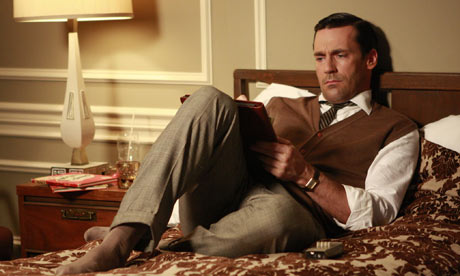
Yes, I realize Don Draper has nothing to do with this post, but -- like me -- he's taking mental notes (and really, any excuse to allude to Mad Men is a good one).

One of the literary agents I follow on Twitter recently posted a link to an old 2006 blog post by Seth Godin, a bestselling author, entrepreneur and self-professed "agent of change." The agent on Twitter highlighted Godin's article as having the best advice for aspiring writers, so naturally I clicked over. Mind you, I've read many authoritative "this is what you need to do" lists on writing and getting published ... and most of them are BS, marketed toward getting me to buy some guide or book on the practice (God, I hate that, but such is the way in any industry I suppose). Godin's points, though, are completely valid and he hammers home the fact that getting published and getting printed are two very different things. One is a business and the other, well, anyone can do!

I just have to keep reminding myself of his most pertinent points:
  1. Lower your expectations. The happiest authors are the ones that don't expect much.
  2. The best time to start promoting your book is three years before it comes out. Three years to build a reputation, build a permission asset, build a blog, build a following, build credibility and build the connections you'll need later.
  3. Pay for an eidtor editor. Not just to fix the typos, but to actually make your ramblings into something that people will choose to read.
  4. Don't try to sell your book to everyone. First, consider this: " 58% of the US adult population never reads another book after high school." Then, consider the fact that among people even willing to buy a book, yours is just a tiny little needle in a very big haystack. Far better to obsess about a little subset of the market--that subset that you have permission to talk with, that subset where you have credibility, and most important, that subset where people just can't live without your book.
  5. Resist with all your might the temptation to hire a publicist to get you on Oprah. First, you won't get on Oprah. Second, it's expensive.
  6. Think really hard before you spend a year trying to please one person in New York to get your book published by a 'real' publisher. You give up a lot of time. You give up a lot of the upside. You give up control over what your book reads like and feels like and how it's promoted. Of course, a contract from Knopf and a seat on Jon Stewart's couch are great things, but so is being the Queen of England. That doesn't mean it's going to happen to you. Far more likely is that you discover how to efficiently publish (either electronically or using Print-On-Demand or a small-run press) a brilliant book that spreads like wildfire among a select group of people.
  7. Your cover matters. Way more than you think. If it didn't, you wouldn't need a book... you could just email people the text.
  8. If you've got the patience, bookstore signings and talking to book clubs by phone are the two lowest-paid but most guaranteed to work methods you have for promoting a really really good book. If you do it 200 times a year, it will pay.
  9. Publishing a book is not the same as printing a book. Publishing is about marketing and sales and distribution and risk. If you don't want to be in that business, don't! Printing a book is trivially easy. Don't let anyone tell you it's not. You'll find plenty of printers who can match the look and feel of the bestselling book of your choice for just a few dollars a copy. That's not the hard part.
  10. Bookstores, in general, are run by absolutely terrific people. Bookstores, in general, are really lousy businesses. They are often where books go to die. While some readers will discover your book in a store, it's way more likely they will discover the book before they get to the store, and the store is just there hoping to have the right book for the right person at the time she wants it. If the match isn't made, no sale.
  11. Writing a book is a tremendous experience. It pays off intellectually. It clarifies your thinking. It builds credibility. It is a living engine of marketing and idea spreading, working every day to deliver your message with authority. You should write one.
Blog Widget by LinkWithin