Showing posts with label inspiration. Show all posts

Friday, August 3, 2012

Antiquing a French Provincial table on a budget

I've been on a Francophile kick lately for the baby girl's nursery theme: French Garden.

Over the past few months I've collected things here and there to try and make this nursery as calm and dreamlike as possible, but furniture was the one area that proved frustrating. I'd love more than anything to waltz into Pottery Barn and scoop up anything I want from their nursery collection, but money is a little tight with all our home remodels, and spending a grand here and there on nursery art and furniture just doesn't seem like the responsible thing to do. Luckily my parents bought us a beautiful new baby crib as a gift, so that was taken care of but I still needed a sidetable and a rocking chair.

After exhausting all searches on the Internet, I hit up my local consignment store looking for any type of table that I could modify. My only requirement? That it have French Provincial legs. Surprisingly these types of tables are more obscure than I thought, but just as I was about to leave the store empty-handed, I noticed this little hutch on provincial legs hiding under a rolled up rug:


(Ignore that goopy stuff on it. This was taken after we brought the thing home and slathered on some stripper compound to get rid of that awful Grandma patina walnut stain.) Grandma-furniture coloring aside, I saw major potential in this piece, especially with the adorable beveled detailing on the drawer and the steel mesh grids on the doors.

Since I'm conveniently pregnant at the moment, I had J work with all chemicals to antique this thing back to life so it would fit in a little girl's nursery. Like the diligent husband he is, J got to work stripping off the icky veneer. . .

This part took about two hours in 90-degree temps. Ugh.
Stripped and ready for painting. Much better already!
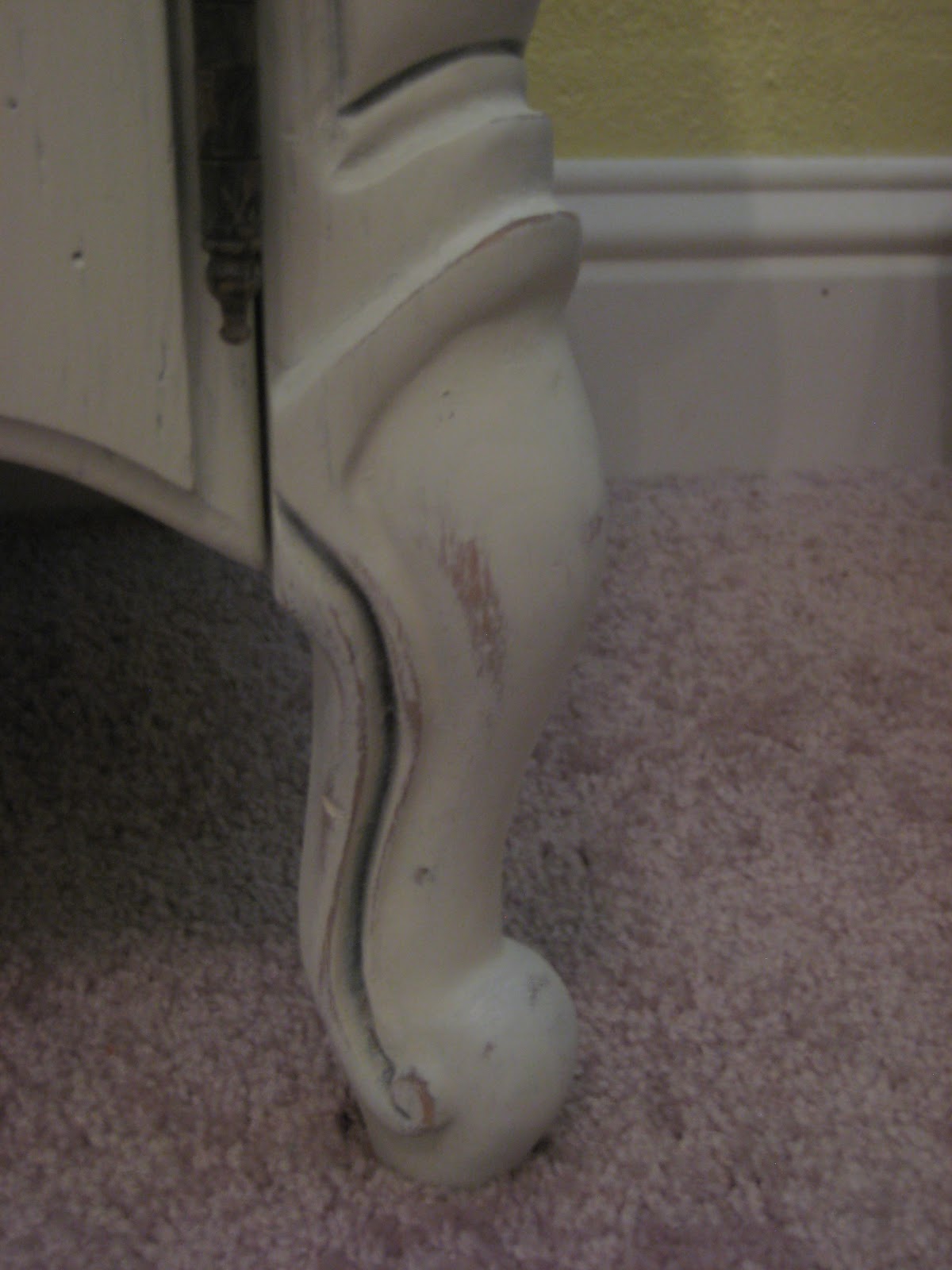
After perusing various design blogs, I decided to have J spray my little table with Rustoleum's "Heirloom White" paint in satin. I'm absolutely obsessed with this color -- it's a slight off-white with no yellow undertones like other off-whites. Two cans of spray paint and a sanding around all beveling and curves later, the final product was magnifique!:


Nice legs.
Love these curves.
The perfect nursery addition.

Materials Breakdown:

French table: $65
Stripper: $5
Mineral Spirits (to clean stripper off): $10
Two cans of spray paint: $8
Sandpaper: $4

Total Cost: $92

At just under a hundred dollars, I would say this project was a success! Especially considering that it was a solid wood piece and a hundred bucks barely gets you a heap of particle board at Target. We're currently at work antiquing a vintage rocker I found at another consignment store -- pics coming soon.

Tuesday, September 14, 2010

A night with Lady Gaga at the Monster Ball


In terms of concerts, the Monster Ball tour I went to last month was definitely in the Top 5 Best Concerts of my life (dare I say she beat out David Bowie when I saw him at the Shrine in LA?)

I got decked out in tranny heels and red lipstick; my bff donned a black and white Rhythm Nation ensemble (complete with fingerless-leather glove), and we had fun people-watching in the lobby before the show started:

This Gaga lookalike (above) only wore these sequin disco boots, booty shorts and hat. The rest of her body was covered with rhinestones.

More little monsters (above).

When all 20,000 of us were packed into the pavilion and the lights dimmed, the crowd erupted into screams and cries, waiting for Gaga to emerge. But first, for the intro, a giant projected video played on a 30-foot white sheet hung above us, hiding the stage behind it:


It was ah-mazing. The visuals mixed with her looped voice saying "I'm a free bitch" over a remix of CeCe Peniston's "Finally" made for the perfect concert intro (and ringtone, if I could just find this version online). The rest of the show -- which was more a "pop-electro opera" -- was spectacular:

Holding her Disco Stick...get it?

One of my favorite parts of the show (above and below) was when she sat down and sang Speechless -- just her and her piano. As she sang the ballad the piano went up in flames.

I mean, who plays a guitar with the stiletto heel of her patent leather boot? Gaga, that's who. Loved!

Singing "So Happy I Could Die" in a moving headpiece (above, below).


What I loved most about Gaga live was that unlike any other act I've seen (and I've been to many concerts), Gaga actually succeeded in creating a connection with her audience. Between each song she'd pause to speak with us as though she and the 20,000 people facing her that night were having an intimate chat over coffee (one-way, of course). I have no idea if she actually does care for her "Little Monsters" as much as she lets on, but the point is she made us believe she cares about us. She made us believe that she wouldn't be where she is without us, her fans, her little monsters. Many stars have spun the "Thank you to my fans" spiel, but none pull it off like Lady Gaga -- her love for her fans seems genuine, and this makes us love her more.

At the concert I also loved how empowering she was to the crowd. At one point between songs, she said (verbatim):

"I've got to know so many of you and you've made me so brave. I wasn't brave before but I'm brave now because of you. So now I'm gonna be brave for you. Tonight I want you to free yourself. I want you to let go of all your insecurities. I want you to reject anyone that's made you feel like you didn't belong or you didn't fit in or told you 'No, you can't do it' or you're not good enough or thin enough or you don't have enough money or you're not pretty enough or you can't sing well enough or dance well enough or play well enough -- you remember that you're a superstar and you were BORN THAT WAY."

"Tonight will be your liberation. YOUR LIBERACION!!" (with a snarl).

That was, without a doubt, my favorite part of the whole night. I knew, right then, that I was a diehard fan.

Monday, July 26, 2010

A tale of two women

Since I started work last Monday (I know you're wondering how it is but I'd rather speak of such things anonymously on an anon blog I'm starting this week), there are things I miss from my pre-work life. Waking up without setting an alarm the night before...writing in the afternoons...lunching with family...staying up late to watch Gone With the Wind (again) on TCM (even though I own it) just because I can. But most of all, I miss hanging out with The Nana.

That six-week period, between when we moved back to California and when I had to start work, was amazing (for lack of a better term, and I know I overuse that word often but I really can't think of any other way to describe it at the moment). Having the freedom of my daylight hours to reconnect with Nana (who I wasn't that close to growing up) was wonderful. Though she's much older now, it was like I was given a second chance to reintroduce myself to her (and vice versa). And all it took was six weeks to erase a lifetime of formality and acquaintance.

It was grand. We'd go shopping every afternoon and scour the aisles at stores all over the tri-county area, filling our carts with nothing we needed but everything we wanted. (Tubes of coral pink lipstick (all her), coffee mugs, dresses, giraffe-print tote boxes, sterling silver wine-stoppers, authentic Portuguese olive oil. You name it, we bought it. (Her cart, suffice to say, was always much more filled than mine -- this was before I had the job, after all.)

We'd leave stores toting our wares in giant plastic bags, laughing the whole way home in her Volvo station wagon or her Land Yacht (a ginormous black Lincoln that belonged to my late grandfather) about the four ceramic chickens (of varying shapes and sizes) that I'd talked her into buying because of her well-documented obsession with the animal (they're all over her house: chicken sculptures, chicken tablecloths, chicken-shaped candles, chicken-print doormats. Heck, she actually just bought a red wingback chair with little chickens embroidered all over it. Without me, of course. I had to work that day. *pouts*)

If we weren't shopping for ceramic chickens or olive oil, than we were doing our other favorite thing together: antiquing. We'd spend hours at consignment shops and antique stores, strolling through the aisles and running our hands -- first old, than young -- across the wooden finishes of old tables and chairs and benches, marveling at the potential in such things with just a bit of sanding and the right stain. It was during these days in particular that I learned a lot from Nana, who's like the Obi Wan Kenobi of antiquing and furniture refinishing. Seriously. I am but a young Jedi when it comes to her knowledge of such things; she's been doing it all her life, back to her Betty Draper years -- yes she was a platinum blond with piercing blue eyes -- when she used to put my dad and his siblings to work sanding down dressers and tables with her in the backyard of their big stately house on a red-brick, tree-lined road in Moline, Illinois.

Anyway, every day the lunching and shopping would draw to a close (usually around 3pm), and we'd make our way back to her house where she'd reminisce about her life over a couple glasses of her classic iced tea (the secret ingredient? Crystal Light). It was during these conversations that I learned far more than I'd ever known about Nana. Sure I'd seen pictures of her back when she was spry (including one of her in a swimsuit on a beach feeding a sandwich to a man, who I should probably add was not my grandfather, on the cover of a 1940s copy of Holiday Magazine), but I never really pictured her having a life before my dad.

It's funny, isn't it? How certain people -- older family members, teachers, etc. -- all get frozen to a particular time period we tether them too? There is no beginning or ending for these kind of people. They just "are" -- held in place in our lives by markers like fathers and mothers, birthdays or graduations, Thanksgivings or Christmases. And any pictures we see of them outside of our parameters don't seem real. Like the Holiday cover my grandmother was on. I see it, but can't conceivably see that woman sitting on the beach, laughing with the sandwich in her hand, is actually who I've come to know as The Nana.

But over our iced teas every afternoon, between our shopping and our furniture refinishing, I began to see Nana as more than just...well...Nana. She actually had a life before she had kids and she even had a life before her marriage in the late '40s. Memories from her go back as far as the Great Depression, when she remembers neighbors and others in the community who'd lost everything come by her parents' house asking for handouts, food, anything to survive. She recounted her parents giving out food (luckily my great-grandparents were never affected by the Depression), and she remembered those people leaving, marking the stairs up to her front door with the symbol that food was being handed out at that address for any other passerbys desperate to eat. (Much like that "Hobo Code" Mad Men episode.)

She'd talk about her vacations in Florida as a young woman (just before she met my grandfather), when she and her girlfriends would dance with WWII GIs returning from the war. Or she'd tell me how some of the most favorite moments in her life were back when she lived in Illinois, near her best friend who also happened to be her sister-in-law. The two of them would load their old Norman Rockwellian station wagon up with all the kids (I believe they had around 11, combined) and antique all day with their children in tow. Just two young women in the 1950s, enjoying their all-American lives full of antiques and picnics and summer trips to Lake Michigan before things got complicated (her SIL fell out of contact after Nana moved to California in the early '60s with my grandfather) and the kids grew up. It's these times, back before the world changed and the country lost its innocence in the mid-'60s and on, that Nana misses most. I can tell by the way she talks about it.

Shortly before I started work, on one of the last full days I had with her before we'd be rescinded to weekends (if that), she told me in the car that she didn't see me as a granddaughter.

"You're more than that," she explained, laughing in disbelief that she even felt that way. "I don't know how to explain it, but I don't feel like you're my 28-year-old granddaughter. I look at you and I don't think of an age; I feel like we're the same age. We get along so well, that you're more of a friend. A good friend." She smiled, and I smiled back.

"Well, age is just a number," I said. "There's no reason why our age difference should be a matter. 20s, 80s, who cares? 'Cause I feel the same way. You're not my grandmother; you're a good friend."

Finally. Not only had we reconnected, but we'd moved past that onto a different, higher plane.

I still see Nana here and there. I try to make it over for dinner once a week and if I have time I stop by on the weekends, but because I work 40+ hours a week it'll never be the same. Then I start feeling differing shades of blue throughout my workday because of it. True, we have that bond that at this point is impervious to time, but still. It's different. I feel -- since starting work -- that there isn't enough time...and Nana's not getting any younger. I sit at my desk in SF, wishing I could be back in that station wagon across the bay, en route to some antique store or new Italian restaurant, listening to her stories. And then I feel sad, as though in a way I'm losing her all over again.

Thursday, July 22, 2010

Book review: "How To Be An American Housewife"

When I was first asked to review How To Be An American Housewife, I was immediately intrigued by the title. I knew it was fiction and not some how-to guide (because really, that would be kind of awkward if they'd actually made a how-to book for acclimating to American domesticity), but the title piqued my interest, especially when juxtaposed against the photo of the Japanese woman set behind it.

It turns out the title was based on a book by the same name that actually did exist back in the 1940s when Japanese women were marrying American GIs in droves during WWII. The novel's author, Margaret Dilloway, noticed an old copy her Japanese mother owned, given by her GI husband (and later Dilloway's father) in an effort to help her acclimate when he first brought her to America. It was this book, which later turned out to be a manual of sorts for Japanese maids and therefore was never read, that was the inspiration behind Dilloway's debut novel of the same name.

How To Be An American Housewife is not only a book about mother/daughter relationships, it's commentary on cultural assimilation. Of yearning to fit into a new culture and land while missing family and letting go of traditions left behind on native soil.

The first half of the novel is narrated by Shoko, a Japanese woman determined to come to America. She marries an American GI she falls in love with much later in life, but her struggles going from Japan to setting up a home near a military base in San Diego, California, are at the same time both humbling and heartbreaking. Dilloway cleverly crafts Shoko's narrative so that everything Shoko thinks is written in perfect English, while everything she communicates to her husband, children's teachers, or fellow parents comes out clunky, broken and distorted (since English is her second language). Through Shoko readers have a window into what it's like as a foreigner in America, of the language barriers and sometimes physical traits that shouldn't but often cast one as "an outsider."

The story continues through Shoko's narrative, gliding along memories she has of experiences in both Japan and America and the transition between, when about half-way through the narrative baton is passed to her American-born daughter, Sue.

Sue is a single mother and working professional with one divorce under her belt. She hates her job, has no love life and feels misunderstood by everyone, including her parents (and especially Shoko). Even though she's in her 30s, Sue still feels like she has no identity since she was raised in a multi-cultural household and loathes the fact that she could never fully fit in growing up; Shoko with her broken English seemed always an embarrassment for Sue at school functions or when she wanted to invite friends over. Even at 30-something, Sue's still not sure where she belongs and because of this has remained quiet, withdrawn and passive -- a wallflower, through and through.

It's only when Shoko asks Sue to travel back to Japan for her to mend a decades-old family argument that Sue (with her daughter in tow) comes into her own as a woman and begins to see the beauty of growing up multi-culturally. The acceptance of her upbringing and heritage (which were both solid but much different than her peers) starts to quickly transform Sue into a new woman, and brings about a level of understanding for her mother and mother's life before America that is fascinating to read.

I recommend this book to anyone who's ever felt like their mothers (or daughters) misunderstand them, or to anyone who's questioned their roots and what it means to be a part of a certain ethnic group. Dilloway's excels at showing the uncomfortable situations Shoko finds herself in once she arrives in America, the loneliness Shoko experiences as she lets go of her past to build her future, and the wallflower Sue who eventually blooms by reconnecting with her origins as a favor to her ailing mother. For a debut novel, I was thoroughly impressed.

Thursday, July 15, 2010

A light rain on my parade of overpriced tapas

So there I was the other day, spinning in the living room with J, our joined hands the still-point of our turning world whizzing behind us in slow motion. After the spinning and the dancing and jovial pouncing was over, we made plans to celebrate my job news at a fancy restaurant, "Va De Vi", nearby (I needed a good reason to drop an unmentionable sum on duck confit, and now I had one). He resumed studying for the Bar (like he does every day) as I left to hang out (like I do every day) at The Nana's, drinking iced tea and refinishing furniture and having lunch with other sweet, old ladies (which I am definitely getting used to. My brother mentioned I'm "becoming a Golden Girl." My response: "You say that like it's a bad thing." Age is really just a number, after all.)

After a good day of lunching and antiquing and discussing how movie stars today just aren't what they used to be (hello, Paul Newman and Cary Grant), I got back to our apartment in time to shower and head to Va De Vi with J. But he had questionably good news.

I guess I should preface this part by letting you in on the fact that J was flown down to Newport Beach last week for an interview at a law firm. The firm does exactly what he wants to do (corporate litigation), all the partners and associates he met clicked with him right away, and the office -- well, from what I heard the office was magnificent (think one of the top floors in the building, all glass windows, with a full view of Newport Harbor and the Pacific Ocean). They wined and dined him (at this point all I thought of was The Firm, minus the corruption and partially cheesy action scenes), and sent him back up to the Bay Area wanting the job.

Flash forward to yesterday. Literally HOURS after I got my job offer that I'd only JUST interviewed for two business days prior, the law firm called J with good news: They wanted to hire him. The salary they offered was (how do I put this) obscene, and the bonuses and profit-sharing were clutch. All in all it was an offer he couldn't refuse. Almost.

I was happy for him but tried to hide my disappointment: a.) We were about to visit a fancy restaurant (something that's been long overdue) to celebrate the good news, but b.) How could I be happy knowing he'd be leaving soon? Which I wouldn't blame him doing -- the pay is more than good, it's exactly the type of law he wants to practice, it sounded like a great work atmosphere and the lifestyle that comes with such opportunities...let's just say they make movies about such things for a reason.

"So why wouldn't he take it?" I thought. This is exactly what we wanted. What we'd waited for. This is why he worked so hard in law school. Or was it?

As we sat at a table in the posh outdoor alleyway, peppered with hundreds of white Christmas lights and low chatter from neighboring tables, I grew even more sad. Ordering a bottle of Malbec did not help (though said Malbec was a deliciously excellent choice) and neither did thinking I saw Robert Redford (my idol) walk by (turned out it was just some older guy with good hair). I was sad not because J was leaving, or because we'd see a lot less of each other. No, I was sad because it finally dawned on me that we were never given a fighting chance as a married couple.

We got married about one month before J started law school and for three years I've waited for him, meaning waited for him to be a "normal" husband, not one who is in law school full-time. Law school has been like the "other woman" in the first three years of our marriage -- years that newlyweds usually spend setting up house apartment and traveling and enjoying being together before things like kids and mortgages start to take effect. They're supposed to be the carefree, let's-spend-time-together-and-enjoy-being-married years. My first three years were not this.

Nearly every day, every week, was taken up by the "other woman" (i.e., law journal meetings and finals and mock trial competitions and internships). There was always something and though J tried his hardest to spread himself thin and be home as much as possible, there were many, many times when he couldn't be. So I tolerated the early years of our marriage, the him-needing-to-stay-late-at-the-library nights, when I'd come home exhausted from my desk job and eat dinners alone watching reruns of Little People, Big World because this was important. He was building the foundation for his life. For our life.

The saving grace during those years, when his seat on the couch sat empty because he was out hoofing it for some DC judge or legal internship, was that there was a light at the end of the tunnel. "The three years would eventually be over," I told myself. And almost as quickly as they started, they were finished.

The final stretch of this leg of the journey is taking the Bar at the end of July and since he has about two months to study for this test that nearly 40%-50% fail their first time in the state of California, he's been studying his little butt off. Every day. Which -- again -- I'm completely fine with. I see it as the last 100 yards in this crazy legal race and (of course) I want him to pass, so all summer he's stayed home studying 10+ hours a day while I chill at The Nana's, glad to be hanging out with someone who likes classic films and Mad Men and shopping as much as I do (these are the perks of knowing someone who doesn't have to work at all).

But now that the Bar is right around the corner, I'm getting excited about being able to see my husband again. ("Again?!" she says, "was there ever a time in this marriage you could?") I know that normal is a subjective term, but I'm ready for a normal marriage (read: one where it's expected that we get to hang out together without a timer beeping when our five minutes is up). And it was looking like things were going to become...normal. I just got that job. We just got this apartment. My friend just dropped off Moneypenny so both our animals are once again under the same roof. We're finally back on the West Coast. To quote Penny Lane from Almost Famous, "It's all happening(!)..."

Then this (otherwise amazing) offer from the Newport firm happens THE SAME DAY as my offer, which by this point I'd already accepted. And nothing felt like it was happening anymore. No more Age of Aquarius or stars aligning, nope, just one, big diamond-encrusted wrench worthy of Lil Jon's toolbox, thrown into the oiled gears of our Master Plan.

But I said none of this. I hid my sadness. This was supposed to be a happy day. One filled with reams of money and pretentious restaurants and funny quips Nana had said that morning remembered over grilled asparagus with panko crusted egg that night. That light at the end of the tunnel -- that pinprick of hope that this would one day be all over and we could actually walk down to the local Farmer's Market together on any given Sunday or finally see movies in theaters again or go out to dinner just because -- it faded to black. That realization alone was enough to ruin my good news. Paper covers rock, and so on. It dawned on me that it would never just be "easy" with us. Things were not, nor did they ever in the last three years, align that way.

As we continued feasting on the tapas that were brought out as prepared, J seemed on edge. Both of us were more quiet than usual. Obviously something was bothering both of us and so he started asking questions of how I felt about it, of what I thought, and everything I just wrote prior to this paragraph began trepidatiously coming out. (I say trepidatious because I'm just happy we're back on the West Coast, close to family and friends and excellent weather. With DC in our rear-view mirror, I really have no more demands.)

Turns out I was wrong thinking he'd automatically accept the position. He shared many of my sentiments and totally saw where I was coming from. His answer back to the firm was not a given "yes", much to my surprise.

Over the next two hours we talked, laughed, drank, ate and discussed the State of Our Marriage -- our wants, expectations, standards, dreams. It all came out on the table (for a couple who communicates all feelings, much of it wasn't new, just reiteration). But many of it needed to be reiterated because, as J put it, we were at a crossroads now. Were we okay with seeing each other on errant weekends (there'd be many weekends where we wouldn't see each other: I'd want to see family and friends, or he'd be expected to network with clients on some golf course)? How would we eventually start a family in a few years if we were apart during those pivotal years leading up to such things?

At one point J and I both got misty-eyed talking about all these real-life, marital issues (confession: I cry easily, especially at those SPCA commercials on TV with Sarah McLaughlin singing in the background) and that's when he said it. On his own accord, even after I insisted this was very much his decision, that I didn't know anything about the legal field and he needed to do what he felt was right for his career.

"I can't do it," he said, pouring himself another glass of Malbec. "I feel like it's a choice between the job and money or you. The firm's offer is attractive and you're right -- it's exactly the law I want to practice. ...But a life without you is pointless."

This is why I married this man.

Later, when we got the check (brought out not in a checkfold like most restaurants, but stuck within the pages of an old book called "La Princessa" -- clever, Va De Vi, clever!), I flipped through the novel as he signed our bill. Dozens of people had signed random pages within this same book, scrawling little notes like "Happy Birthday, Jim!" or "Happy 20th Anniversary, L + M, 2009" or "Life would be perfect if I could eat at Va De Vi everyday." I laughed and pointed out the hundreds of notes left in the margins to J.

He signed his name to our check then took the book from my hands. Turning to a middle page (I believe it was page 51), he wrote "To hell with the Newport job" in the margins, stuck our check in, and closed the book, smiling.

That note said it all.

Wednesday, June 30, 2010

Poverty Sucks

I was at The Nana's house yesterday going through some old framed art she had when I came across this delightful poster:

I think this about sums up poverty versus wealth perfectly.

Friday, June 25, 2010

A letter to men, by Christina Hendricks

"One minute you're on top of the world, the next minute some secretary is running you over with a lawn mower."

In honor of the Mad Men Season 4 premiere in exactly one month (July 25th -- set your DVRs!), every Friday leading up to the fated night I'll be running a post related to the show and/or its actors. Today is an open letter to men penned by Christina Hendricks for Esquire in April.

I love that when it comes to men, Christina seems just as confident as the Joan Holloway character she plays. As copywriter Paul Kinsey said: “Jackie Kennedy and Marilyn Monroe — every woman is one of them. ...Though Marilyn's more of a Joan, not the other way around.”

And here's why (in her own words):

We love your body. If we're in love with you, we love your body. Your potbelly, everything. Even if you're insecure about something, we love your body. You feel like you're not this or that? We love your body. We embrace everything. Because it's you.

Speaking of your body, you don't understand the power of your own smell. Any woman who is currently with a man is with him partly because she loves the way he smells. And if we haven't smelled you for a day or two and then we suddenly are within inches of you, we swoon. We get light-headed. It's intoxicating. It's heady.

We remember forever what you say about the bodies of other women. When you mention in passing that a certain woman is attractive — could be someone in the office, a woman on the street, a celebrity, any woman in the world, really — your comment goes into a steel box and it stays there forever. We will file the comment under "Women He Finds Attractive." It's not about whether or not we approve of the comment. It's about learning what you think is sexy and how we might be able to convey it. It's about keeping our man by knowing what he likes.

We also remember everything you say about our bodies, be it good or bad. Doesn't matter if it's a compliment. Could be just a comment. Those things you say are stored away in the steel box, and we remember these things verbatim. We remember what you were wearing and the street corner you were standing on when you said it.

Remember what we like. When I first started dating my husband, I had this weird fascination with the circus and clowns and old carnival things and sideshow freaks and all that. About a month after we started dating, he bought me this amazing black-and-white photo book on the circus in the 1930s, and I started sobbing. Which freaked him out. I thought, Oh, my God, I mentioned this three or four weeks ago and talked about it briefly, but he was really listening to me. And he actually went out and researched and found this thing for me. It was amazing.

We want you to order Scotch. It's the most impressive drink order. It's classic. It's sexy. Such a rich color. The glass, the smell. It's not watered down with fruit juice. It's Scotch. And you ordered it.

Stand up, open a door, offer a jacket. We talk about it with our friends after you do it. We say, "Can you believe he stood up when I approached the table?" It makes us feel important. And it makes you important because we talk about it.

No shorts that go below the knee. The ones almost like capri pants, the ones that hover somewhere between the kneecap and the calf? Enough with those shorts. They are the most embarrassing pants in the world. They should never be worn. No woman likes those.

Also, no tank tops. In public at least. A tank top is underwear. You're walking around in your underwear. Too much.

You don't know this, but when we come back from a date, we feel awkward about that transition from our cute outfit into sexy lingerie. We don't know how to do this gracefully. It's embarrassing. We have to find a way to slip into another room, put on the outfit as if it all happened very easily, and then come out and it's: Look at me! Look at the sexy thing I've done! For you, it's the blink of an eye. It's all very embarrassing. Just so you know.

Panties is a wonderful word. When did you stop saying "panties"? It's sexy. It's girlie. It's naughty. Say it more.

About ogling: The men who look, they really look. It doesn't insult us. It doesn't faze us, really. It's just — well, it's a little infantile. Which is ironic, isn't it? The men who constantly stare at our breasts are never the men we're attracted to.

Marriage changes very little. The only things that will get a married man laid that won't get a single man laid are adultery and whores. Intelligence and humor (and your smell) are what get you laid. That's what got you laid when you were single. That's what gets you laid when you're married. Everything still works in marriage: especially intelligence and humor. Because the sexiest thing is to know you.

Wednesday, June 16, 2010

Back when life was simple

...my to-do lists resembled these:

(images via HuffPo)

Now they include:
  • Find reasonably priced apartment in an unreasonably priced Bay Area neighborhood.
  • Go grocery shopping.
  • Cancel private health insurance. (This alone is a tedious task: For the reams of bureaucracy involved, no one's ever accused BlueCross of being efficient of all things. During my last year of coverage I couldn't even pay my monthly bill online; according to them it had to be done by check -- remember checks? -- through the mail. Welcome to the 21st century.)
  • Pay bills.
  • Get new tires for car (because all I really want to do on a sunny Saturday afternoon is spend time inhaling rubber vapors in Costco and Big-O Tires, looking for the best deal)
  • Save some semblance of a down-payment for the start of my real estate empire my first house.
  • Figure out how I'm going to conceivably own a Porsche 911 before my 35th birthday.
  • Give Lola a haircut (which takes longer than one would think since her haircuts are somewhat akin to shearing a sheep.)
  • Work.
Not as fun as eating ice pops, folding "close", and staring at this alleged Isaac fellow, but it could be much worse. I hope I never have to add "attend three rounds of chemo", "file for divorce", or "ask everyone I know for money because I'm broke" to my to-do list. Though my current list of priorities has changed drastically from the one I wrote at age 5 (the one that included "eat my tube of cherry chapstick") I'm happy with where I'm at. Some things are meant to change with age. This includes ingesting lip balm.

Tuesday, June 8, 2010

The "Ain't Nothing Wrong With Freedom, Man" Trip across America, in words

Little did I know when we started out on this hallowed journey toward Valhalla we'd wind up face-to-face with a mama Grizzly, defending her cubs who just happened to find the beef jerky in our now-clawed-open car just as satisfying as we did. Apparently Lola had done little to satiate their hunger earlier in the night when we discovered she'd gone missing on a routine potty break. With J wielding a hatchet behind me, the Grizzly now charging toward us with her snout wrinkled and teeth bared, I gripped the hunting knife in my white-knuckled hands and....

Got your attention yet? Good. Cause none of that happened although it would have been sweet if it did. Ditto if we had found ourselves in the path of some giant tornado, J, Lola and I strapped to a random pole on a Kansas farm by nothing but a leather belt, Twister-style. But that didn't happen either.

We encountered no killer mosquitoes, vengeful bears or creepy toothless truckers (okay, maybe a couple) on our "Ain't Nothing Wrong With Freedom, Man" Trip Across America (a name we borrowed from a Dennis Hopper line in Easy Rider). In fact, for such an unplanned cross-country jaunt it went surprisingly well, save for a slight...situation...near the South Dakota/Wyoming border. But even that was more funny than terrible (to me, at least. J: not so happy.) With that, here are the highlights of our journey:

After two days straight of driving on the road, taking turns sleeping while the other drove, fatigue began to set in somewhere in Iowa around midnight. And of course we happened to be on one long stretch of freeway that had NO exits for what seemed like a hundred miles or so. Just the road in front of us, dark cow pastures on either side. I could barely keep my eyes open. "Must...get...to...South Dakota..." I murmured, as exhaustion continued lulling my eyelids closed. J kept yelling at me to stay awake until we could pull over but after a while his yells were useless against my fatigue, so we switched places in the cab like a deranged Cirque de Soleil trapeze act while our truck roared down the freeway. I know what you're thinking and in hindsight I don't recommend anyone attempt this, but the alternative was either a.) die in a horrible truck accident by falling asleep at the wheel, or b.) die in a horrible truck accident by parking our vehicle on the narrow highway shoulder and risk getting hit by one of the many passing Big Rigs traveling at speeds of 85+ mph. Seriously.

When we finally found an off-ramp we pulled off the highway and into the parking lot of some hybrid truck stop slash dive bar. (There was nothing else around.) Nestled between parked Big Rigs, we pulled out our sleeping bags and climbed into the front seats of our Hyundai on the tow cart. The air reeked of cow manure and the smattering of semis parked in the lot had their engines running all night for what I think was air conditioning in their sleeping cabs, but I'm not sure. All I knew was that after two days of pounding hundreds of miles of pavement, all I wanted was a few hours of sleep beneath my polyester sleeping bag. As terrible as it sounds it was actually fun. I'd finally become a nomad.

During our second night in Iowa we drove through a town called Sac City and though it was all closed up for the evening, it was fascinating. Sac City is a sleepy little village only a few blocks long, built next to a two-lane thoroughfare that winds through the center of Iowa. There's a small high school (or K-12, I wasn't sure), a community center, a post office, a convenience store, a few charming storefronts selling antiques and other oddities, and a handful of locally owned eateries. Most driving through would probably find it un-amazing but something about it intrigued me enough to comment out loud that I'd love to come back and stay at a B&B. Someday we will go back.

Our first "real" stop -- meaning we actually hung out for a few hours in said place -- was Mitchell, South Dakota, home to the infamous Corn Palace. "How hokey," you might think. "A whole palace made of corn?" Yes. And it's phenomenal. It's not entirely made of corn anymore, though I think when it was first built it was (imagine the popcorn potential in such a place!). Anyway, while the Corn Palace was delightful I was even more intrigued by Mitchell itself. Mitchell was and is the kind of community Norman Rockwell painted in all those Saturday Evening Post covers. We wandered in and off the main street and were greeted with warm smiles from locals as they went about their daily business. Even stopping in a local coffee shop was fabulous -- the barista and cashier were genuine, happy and hospitable. It was a nice respite from what we'd grown accustomed to out East. I'm delighted that this kind of town still exists...the kind of place where everybody knows your name.

Next stop was Badlands, South Dakota, where we set up camp for a night. Badlands is a peculiar but stunning national park filled with craggy stalagmite-looking rock formations in the middle of the Dakota plains. Once inside the park it feels like you're on the moon. It's barren, solitary and captivating. The winds had picked up by the time we pulled our tent out that afternoon and it was high comedy helping J set up everything while 30mph winds whipped past our faces and gear. J tends to lose his patience in situations like these so I have some hilarious pictures of him as he struggled with pieces of tent that ended up wrapped around him like a superhero cape. Of course, it didn't help that I was howling with laughter as I continued taking pictures of his plight. He's such a lucky man to be married to me. ;)

The next day after Badlands we stopped at Wall Drug Store on our way to Black Hills National Forest. I know, I know, what's the big deal about some old drug store, right? Well, everything, actually. This particular drug store takes its name from the town of Wall, South Dakota, where it's located. Wall used to be known by locals as "the geographical center of nowhere," until a guy started Wall Drug Store and saved it through the Great Depression by using an advertising gimmick of offering "free ice water" to any customers. To this day Wall Drug still serves free ice water and 5-cent coffee (along with a plethora of cheesy South Dakota tourism merchandise and some of the best homemade fudge I've eaten in my life). Wall Drug is known around the world because of the hand-painted wooden signs that advertise their business globally. Apparently there are Wall Drug signs promoting free ice water in places like London, Kenya, and even in the Paris Metro. The more you know.

Later that day we cruised into the Black Hills National Forest near the South Dakota/Wyoming border. Herein is where our story takes a turn for the ridiculous, kiddies. We were uber excited as we drove past the ranger entrance. After all, the Black Hills are home to some fabulous sites: Mount Rushmore, Jewel Caves, the old outlaw town of Deadwood where Calamity Jane out-drank her male counterparts and Wild Bill Hickok was eventually gunned down. Oh and buffalo. We couldn't wait to see buffalo. Our plan was find a campsite, set up the tent, take the car off the hitch and use it to drive around the forest (the mountains would have been much harder to traverse in our Budget Truck). So we found a campsite and as J unloaded our gear I patiently waited, suddenly writhing like a spastic each time I'd hear a buzzing in my ear from one of the many wasps who had found our campsite just as splendid as we did.

Once J was finished he circled our car on its hitch, undoing the four chains that held it in place (two in the front, two in back). As he climbed into the car and started the engine I suppose I should have been paying more attention from my vantage point on the street because as soon he backed off the hitch there was a loud pop...or was it a crunch? I can't remember now but all I can recollect was that it was a hideous sound. An expensive sound.

"I think you bottomed out!" I yelled over the engine. But the minute he peered out the window and I watched the blood drain from his face, I saw exactly what the problem was. The left tire behind him was completely crooked, and was now turned at an obnoxious, wall-eyed angle. Apparently he'd forgotten to take the rear chains off and the left axle thing (don't you love how technical I am?) was completely bent.

Ugh.

The funny thing? After the initial shock wore off I just couldn't be angry. Of all places and times for something like that to happen -- Mount Rushmore was supposed to be the peak of our journey -- we now had a car that could barely move, much less make it up a steep mountain to see the Four Heads. How could I not laugh? We deliberated for a moment before I decided we should just pack up all our gear and try to see Mount Rushmore on our way out of the park that evening. The sun was already beginning to set and there was no sense staying at the campsite for two nights when we wouldn't have easy access to climb all those hills around us comfortably in a smaller car. So we left.

Mount Rushmore was, of course, magnificent and we got to catch a lighting ceremony around 9:30pm which made it even better. But by the time we pulled out of the parking lot there we were exhausted. It had been a long, hot day, filled with stops at famous drug stores and absent-minded wrecking of rear car axles. So we stopped in a tiny tourist town just a few miles down the winding forest road from the monument, but the first motel in said town cost $120 -- $120! For what looked like an inimical den full of bedbugs and tired slot machines -- so we decided to keep driving...the entire length of the Black Hills. At this time it was around 11pm and though we only had about 30 miles to get out of the national park, they were 30 miles of steep elevations and harrowing descents. Not the ideal setting for a full moving truck with car hitch.

It was silent during most of the ride, but there was palpable tension in the air. We each gritted our teeth, J behind the wheel, me in the passenger seat, as we silently hoped the truck wouldn't break down climbing one of the many mountains at 10mph, or even worse lose its brakes as we descended each 7% grade. We managed to drive through Deadwood on our way out, which was cool since it still remains an "outlaw"-style town with antiquated storefronts, saloons, hotels, restaurants and city streetlamps. I can't wait till we return and I can spend more than just 5 minutes there.

Finally, finally!, as the Budget truck was seemingly on its last knee, coughing and sputtering up the final behemoth of a mountain, we reached the main freeway and exited the Black Hills. The first town we came upon was a place called Spearfish and we ended up crashing at a Howard Johnson there (which, I should mention, had peculiar taxidermy fowl strategically placed on the walls above the check-in desk in the "lobby" if you could call it that. It was very Psycho, and I half-expected to see Norman Bates walk out from back, asking if we'd like a room and to possibly meet his mother. But there was no Norman Bates, only a middle-aged, tired-looking man with a thick Russian accent who knocked five bucks off the price of the room because he could tell I needed a break).

All I cared about was a.) taking a shower (it had been days since we bathed and though I was a trooper about the whole camping thing, even about the bugs, I couldn't wait to have access to soap and running water. Especially since temperatures had been hot the whole week. Yummy.), and b.) sleeping. That night I fully appreciated the merits of a hot shower and warm, clean bed. Too many of us take for granted those everyday things.

After we awoke in Spearfish and checked out of the HoJo we crossed the South Dakota border into Wyoming en route to Devils Tower. Devils Tower basically looks like a giant slab of clay that someone stuck in a forested area of the corner of the state. My description does not do it justice because it's magnificent. I think it's about 900 feet tall and deep grooves are etched up and down the length it, making it look like a giant bear sharpened its claws on all sides (which is actually the Indian legend about the monument). From our campsite we had a sweet view of the Tower and were even conveniently located next to a Prairie Dog town in the park, where hundreds of thousands of burrowing chipmunk-looking animals would "bark" (or more like squeak) at passing walkers and cars as they protected the openings of their burrows. Later that afternoon J decided he wanted to hike up around the base of the Tower, and though it was hot I trudged along, climbing to an elevation of probably around 300 feet, which gave us spectacular views of the land down below.

That night at Devils Tower it rained. Luckily our tent was waterproof but sometime after the rains stopped it began getting cold. Butt cold. The kind of cold where two hoodies and a pair of flannel pajama pants wasn't enough. I hunkered deep into my polyester Target sleeping bag, which wasn't equipped for such temperatures and would probably have been better suited as a slumber party bag on a living room floor. I remember hoping I wouldn't freeze to death sometime in the night, like Jack Nicholson did in the final scene of The Shining. All night long I'd wake up to my teeth chattering, I'd check on Lola beneath her blanket, and then try to fall back asleep as I wondered how many giant ants I'd squashed under our tent base as I lay there freezing to death.

But I survived. The next morning temps returned to normal and we packed up yet again, hoping to make it to Salt Lake City by nightfall. We crossed the state of Wyoming in almost a perfect diagonal, fighting fierce winds the entire way. J mentioned we were only getting 5 miles a gallon through most of that leg of the trip. Once we reached Salt Lake City we found a motel near the airport (we didn't know SLC at all and had no clue what area we were in, but things often look better at night). In the morning we were pleasantly amused with our surroundings. Especially when I witnessed a blatant drug deal go down at the gas station across the street around 8:30 in the morning. Oh and speaking of drug deals, I also watched one transpire at a gas station in Casper, Wyoming. My guess it was probably meth since it seems meth use in these cities is abnormally high (many anti-meth billboards dot main thoroughfares). Sad.

From Salt Lake City we blasted across the rest of Utah and the entire state of Nevada until we reached Reno. Our plan was to stay in Reno for the night but as we drove through the downtown casino area my heart sank with every block. Reno was just as seedy as people say. There were blocks upon blocks of broken down, abandoned motels, many filled with squatters and people who'd taken up residence in whatever rooms they could find. Old barbecues and car parts lay sitting outside dingy motel doors and front offices, many of these places actually advertising they had vacancies. The last thing I wanted was the contents of our truck stolen (we were, after all, carrying my three seasons of Mad Men, people), so we continued on the freeway past a few upscale housing developments until we reached a solitary resort and casino called Boomtown on a hill outside of Reno's lines. It seemed we stumbled upon a retiree's heaven. There were numerous luxury RVs parked outside and we were by the far the youngest couple on the casino floor. This I could handle. For $50 we got an excellent hotel room and had fun that night listening to a live motown band and gambling with a few dollars at the slot machines. It was a very Hunter S. Thompson-esque way of ending our cross-country roadtrip. Fear and Loathing in Boomtown.

The next morning we crossed the final state line and within 4 hours were home. Throughout our trip pounds of beef jerky were consumed, along with copious amounts of fast food and the occasional slurpee for good measure. And we even got to see a couple buffalo in South Dakota. All in all, it was an amazing trip.

I was going to post photos but this has become a novella, so I'll throw up photos in a pictorial essay in a day or two. I know I've been blogging erratically but once we're settled I'll be back to my normal blogging routine.

Oh and in case you were wondering, J just fixed our car (how I love being married to a man that knows cars.) The part was only $60 and his labor was free. Score. It took him 6 hours to get the two bolts off (they'd completely rusted through because of the DC humidity), but once they were off it took a mere 15 minutes to put the new piece on. I helped out, true to form, in a fabulous new floppy sunhat and heels, as I sat in the shade and kept him entertained with rousing conversation. Again, he's a lucky man.

Thursday, May 20, 2010

Book review: "Let the Great World Spin"

Lately I've become jaded with the whole NYC-as-the-stillpoint-of-the-turning-universe thing. I've heard just about every story that could be told about Manhattan and its outer boroughs, from Annie Hall to Taxi Driver and everything before, between, and after. I'm tired of reading about life in New York. That is, until I read Colum McCann's fantastic new novel, “Let the Great World Spin”.

Before receiving my copy to participate in an online book tour, I researched critical acclaim for the text and tried not to roll my eyes. Another novel about what it means to be a New Yorker? Just what the world needs, I thought. And that was the mentality I went into reading the book with, which was foolish since after finishing my copy I can honestly say that “Let the Great World Spin” is one of the best novels I've read in a long time and deserves all the acclaim and accolades it has received (it won the 2009 National Book Award and was Amazon's “Best of the Month” pick in June of last year).

It's August of 1974, when the Vietnam War is still simmering and tensions in the city are high. Real-life tightrope walker Philippe Petit decides to walk thousands of feet above Manhattan across a tightrope between the World Trade Center towers, and so he does after practicing for months at his country cabin and illegally rigging up a rope with friends. But McCann's novel doesn't focus on the factual Petit or his tightrope walking feat – it's about the native New Yorkers watching the spectacle above while their own lives tread more or less in chaos.

The story begins far below the tight rope, on street corners in the crime-riddled Bronx and swanky apartments on the Upper East Side. McCann deftly weaves together a dozen or so different narratives – each chapter is from a different character's point of view – from New Yorkers of different ethnicities, religions and socioeconomic statuses. Each character is tethered to the next through tenuous, claustrophobic and often purely coincidental relationships based on occupation and social standing.

The first chapter begins with two brothers, Corrigan and Cairan, raised by a single mother in Ireland. As fate would have it both brothers end up in New York as adults, first Corrigan and then Cairan, who travels across the Atlantic in search of his brother only to find him living in Bronx squalor—with heroin needles lining the street gutters and hookers hanging on every corner. Corrigan has come to New York in search of “a fully believable God, one you could find in the grime of everyday” and he finds it in the hookers he befriends and tries to help, buying them coffee and allowing them to use the bathroom in his dingy apartment. Only Cairan, as a newcomer, can see that his brother's attempts are futile, that Corrigan can not save any of these people, least not himself because he provides until he has nothing left to give emotionally, financially, or spiritually.

From there McCann transports us to a tony apartment on Park Avenue, where the wife of a Manhattan judge sits nervously awaiting a group of ladies – a support group of sorts – who all share a common bond: Sons killed in the Vietnam War. Then the next chapter glides like a panning camera lens to two young artist newlyweds, children of privilege with simmering marital problems, smoking a joint as they race down the FDR and cause a horrific crash that changes the trajectory of a handful of characters in the book, including Cairan, the newcomer to New York City. Pages after there is another narrative, of the Park Avenue housewife's husband who became a judge to try and make the world, or at least New York, a better place only to realize during his first day in court faced with pimps and prostitutes that none of his rulings could ever clean up New York's streets.

For me the most heartbreaking chapter was “This is the House that Horse Built,” where one of the hookers introduced earlier in the book gives a tragic first-hand account of how she fell into a life of prostitution and heroin, and how her daughter eventually followed suit. It was a painful reminder of how poverty and addiction can be gaping, cyclical holes that swallow people whole—people who are past the point of being saved.

The tightrope walker high above all these characters is a metaphor for the lives of not only all New Yorkers, but people in general. Each of us, at least once if not constantly, “walk a tightrope just one inch off the ground.” Though the Twin Towers are now gone, with nothing more than open space where the pinnacles of the modern world used to stand, Petit walking his rope high above Manhattan in the late summer of '74 was and is a reminder of humanity and compassion, courage and awe, then and now. I have to agree with Dave Eggers when he called the book “one of the greatest-ever novels about New York.”

Thursday, April 22, 2010

Overheard last night

Paul and Julia Child, one of my favorite couples.

9:45 pm. Our studio. I sit on the couch, feet up on coffee table, laptop balanced in front of me as I edit Chapter 7 of the book. J sits across from me on a pillow he's using as extra padding on the worthless Target chair we bought the year we married. Two or three thick textbooks are cracked open on the table in front of him as he outlines for his last semester of finals on his laptop. I've attempted to catch his attention multiple times tonight. . . dancing seductively near him with finger cymbals, pretending like there's a fire in the kitchen, even lying across his books like a petulant housecat. But to no avail. There's always some other legal pad or some other book that his overzealous eyes can devour in their quest for straight A's. Sigh
. TV flickers silently in background as I wait for the season finale of Project Runway to start in 15 minutes. . . but I can always watch it later online. Tonight I want to run amok and howl at the moon.

Me: "Why don't we go paint the town red tonight?"

J (without looking up from books): "Because we can't afford paint."

Silence for a few moments, then we lock eyes and laugh out loud.

"I'm working on it, my Love. I'm working on it," he says, tapping the edge of the book with his pen.

"As am I," I say.

Studying slash editing resumes on both sides of the coffee table.

Teamwork, humor, patience. Julia and Paul had it. Apparently so do we.

(Ed. Update: Just got mentioned again on MediaBistro! Thank you J, for your witty responses to everything I ask you.)

Sunday, April 18, 2010

A bold fresh piece of humanity


Well, we made it this far. Today yours truly is 28 years young.

I never thought I'd actually be 28, as it sounded so old and mature back when I was spry, but I have to say I don't feel that much different. Not older. Not wiser (even a genius like me has limits). Definitely not more mature. When people ask "How old are you" I still blurt out, "24..." followed with a quick "Oops, er, I mean, 28." Guess this automatic response means I'll always be 24 at heart?

Anyway, I've resolved to make 28 the best year of my life. How so, you ask? I have no clue. But I will.

I'll try more things I've never done; say "yes" more than "no"; dance more; sing more; send out more of my short stories, keep chugging away at novel after novel; listen to music louder; learn to cook as well as Tony Bourdain; possibly even meet? Bourdain (I would die, that would be ah-mazing); pay homage to my youth by getting into the best physical shape of my life and finally take those professional pin-up pics I've been wanting forever; invest in an apartment complex (or five) as part of my retirement plan; force persuade J to learn the dance at the end of Dirty Dancing with me; be completely fluent in Farsi; listen to more Journey (if that's even humanely possible); be Gilda:


I want to live. Really live. I've done an excellent job of living to this point, but now I want to ramp it up a notch. I'm 28, after all. I want to go to the big annual New Orleans Jazz Festival; I want to bicycle down the length of California (and then possibly tackle bicycling cross country); I want to eat what's been called "the best sushi on the planet" at the hole-in-the-wall sushi joint Sukiyabashi Jiro in Tokyo; I want to get seriously involved in making puppy mills illegal (I hope it helps that after this summer I'll be married to a law student lawyer); I want to go salsa dancing on a regular basis; I want to join a book club; I want to dance in a fountain and publicly blame it on the wine (only J and I would know that all I had to drink was water); I want to see a tornado in the flesh; I want to be an expat for at least a year of my life; I want to live near my brother and sister so I can stop by at a moment's notice and vice versa; I want to break bad in some way or another.

I want to go wine tasting in Santa Barbara and pretend to know what I'm talking about as I swish Zin across my palette; I want to get my books published and see my name on the spine of a copy (or three) at a bookstore; I want to go camping cross-country; I want to laugh so hard I puke (J beat me to this one); I want to read everything F. Scott Fitzgerald's ever written; I want to try going blonde for a spell just to see what I'd look like; I want to rent a sparse flat in Florence and write near an open window with a view of the Ponte Vecchio; I want to sit down with my two grandmothers (who are 98 and 85, respectively) and let them each recount their life stories into my voice-recorder, then I want to do the same with my parents; I want to drive a black Porsche 911 Carrera and feel the leather steering wheel gripped in my hands (even if it's just for a test-drive down a few miles of 101 on a slow Saturday afternoon. Hey, the sales guy doesn't need to know I'm not actually serious about buying).

Foolish? We'll see. I can't possibly accomplish all of these things and more in a year, but I can start by accomplishing some. The point is I've laid down the gauntlet. This will be the year that's going to kick me into a higher gear. Life is short; I want to experience as much as I can.

Theme song to kick-start 28: "Foolish Heart" by Journey Steve Perry, on loud.


Wednesday, March 31, 2010

What makes home

Two days ago I drifted awake in my childhood bedroom. For a minute I had no idea where I was. By an act of God was I (finally) waking up in some seaside hotel room in Barcelona? Heaven? (The thought flickered when the glow-in-the-dark stars above me came more into focus.) Was I back in DC, surrounded by unpacked boxes, just waiting for the smell of my neighbor's chicken curry to waft down the hallway and under the gap beneath our front door? Then I heard what sounded like muffled warfare in Kuwait in the next room and instantly knew.

I was home.

And not only that, both my brother and sister were home too. (The simulated warfare was thanks to my video-game loving brother.) Just like in The Royal Tenenbaums my parents had, once again, found all three of their children living together under the same roof. At least for this week.

I smiled to myself in bed, wiping the sleep from my bleary eyes, half-surprised by the hot water pad lying next to me. My mother insisted the night before that I sleep with it to keep me warm, and I think in some odd way it's supposed to make me feel okay without J here. The strange thing is it almost does. Granted J is not made from rubber and poured full of boiling water every night, but the warmth was calming, like most things here are.

There's something so comforting about being home. Always has been. No matter how many places I've lived in and apartment keys I've carried, home to me has always been this house, where some centerpiece made of citrus fruits always adorns our dining room table, where there is no dearth of ice cream in the freezer, and where the same green lamp I've had since I was a kid sits on the new nightstand in my old bedroom.

To most the lamp would look like nothing more than a dated relic from the '70s, but I see so much when I look at it. It makes me think of slumber parties I had in elementary school of now faceless girls I can't remember the names of -- girls I thought would be my best friends my whole life, the lamp behind them shining as the only constant. Then I remember the familiar click, click of the light switch as I'd scramble to switch the lamp off when I'd hear one of my parents' approaching my bedroom door to scold me for staying up so late (in my defense I was reading -- even at 12 I was a book nerd). I remember, later, the lectures I'd have to listen to from my parents in high school, the lamp on behind me, as I'd roll my eyes and cross my arms in defiance against whatever it was they were reprimanding me about. (Usually it had to do with boys. Sigh.) They couldn't possibly understand, I'd think. When they were done talking they would leave and I'd remember how angry I was as I'd click that green lamp off for the night and fume. Then college came and I packed up most of my things, excited to embark on a new chapter of my life. The lamp was left on my nightstand, the clutter gone but it and other staples remaining. And it's still here, to this day. Some of the furniture has changed and the walls have been painted over and I'm older now and married, but the lamp remains. This is what makes home for me.

Of course, it wouldn't be home without a few stock occurrences, either. Like having my picture taken by my over-zealous, camera-wielding sister. Having pics taken is fine; I'm definitely not camera shy. But photogenic I am not. And the routine is always the same: She shows me her pictures seconds after they're taken, I balk at how disgusting I look (Josie Grosie, anyone?), and she disagrees. Seriously, I look good in 1 out of every 5 pictures, and that's on a good day. So I remind her to please not put them on Facebook because the last thing I want is them going public, then an hour later I get a new Facebook email: "You have 8 new photos tagged of you!" I sigh loudly, click over, and yup. There they all are. All of me in my talking-with-my-mouth-frozen-halfway-open-and-eyes-mid-blink glory, which usually looks something like this:


Anyway, once I was wide awake in bed and certain I wasn't in Barcelona or Heaven (I'd hope neither would include the staccato of distant machine guns I heard coming from my brother's room), I hopped out of bed and thrust open my blinds a la Carrie Bradshaw in Paris when she flings open her curtains on her hotel balcony and sees the Eiffel Tower. Except there was no Eiffel Tower here. Only California sunshine. Buckets full, streaming in through the window and slopped across the carpet I stood on. It was a beautiful day and I had had an excellent Friday the day before. I smelled the ocean in the air and smiled. Today was going to be excellent, I could just feel it. So I headed upstairs to the living room, the smell of the ocean reminding me that I really needed to pick up more Steinbeck, maybe I hadn't given him a proper chance when I ...

My foot suddenly landed in a giant, cold puddle on the top step. The blood ran from my face and I froze, slowly lifting my foot up. I looked down in horror at the glistening pool on the hardwood floor, a yellow puddle that had obviously been sitting there overnight, eating away at the wood like a termite in heat. Steinbeck, sunshine, everything fell from my mind as my lips were unable to form any cohesive words. My eyes rose from the puddle to Moxie, my sister's Maltese who some of you might remember pooped on her lap a couple months ago and who I'm convinced has some severe learning disorder. (At times Moxie reminds me of a schizophrenic mallard.) She sat in her bed nearby, beady black eyes fixed on me, looking quite content that her arch nemesis had stepped in her elaborate scheme.

And I was about to yell...but I couldn't. Maybe it was the sunshine coming in from the skylights above us. Maybe it was the fact that I couldn't be mad at a mentally disabled dog. Whatever it was I grimaced at her and hobbled back downstairs to my bathroom on one foot. As I sat on the lip of the tub, sudsing up my sole, I realized that whether I liked it or not, Moxie had become a part of our home. Just like Lola had done before her (although lets face it, if pitted in a game of intelligence Lola would be solving global warming while Moxie would be finding some lap to defecate in).

But that's what a home is. It's all the bad with the good. The hard times with the easy times. The beauty with the ugliness, the tragedy with the success, the sanguine with the gloom. Without each side it wouldn't be a complete home. So no matter how uncalled for some things are, like fights or yellow puddles, they're a part of the entire cocktail. And the inanimate constants, like my green lamp, are the reminders of it all.
Blog Widget by LinkWithin